


Crossdressing, eloping with a lover via the river Thames, violent street encounters, “honest” (or dishonest?) watermen, a woman being rescued from state custody by her friends: these all sound like plot points in Renaissance drama (and, broadly speaking, often are), but they are also part of the life of Elizabethan London itself. However fantastical, ridiculous, or far removed some of the plots of early modern drama might seem, a glance at court records and City council documents suggest that the intricacies and conspiracies of the stage might well ring true for the men and women in the audience. Two anecdotes in particular bear out the relationship between gender identity, appearance, desire, plots, and danger on stage and in the streets…
***
The majority of the earliest plays in our corpus are particularly concerned with female characters and, indeed, are often named after them: The Three Ladies of London [1581]; The Rare Triumphs of Love and Fortune (1582); Campaspe (1583); Fedele and Fortunio (1583); Sapho and Phao (1584); Galatea (1584). These plays are also involved with exploring questions of female agency, desire, and control. Our first Read Not Dead on the 14 May—a brilliant staging of The Rare Triumphs (a write-up is on its way!)—showed how challenges to patriarchal authority on earth, and implicitly in the heavens, are central to both dramatic plot and dramatic structure. In Rare Triumphs, the romantic heroine Fidelia defies her father and refuses to part from her lover Hermione—at one point eloping with him to his father’s unappealing “darksome cell” (that is, a “hollow cave”). At the same time, despite a lot of lip-service to Jupiter’s overarching authority, the “chief” deity disappears promptly after the first act, not to be seen again, and it’s left to Love and Fortune to mend their ways and fashion a resolution for the earthly lovers and their surrounding courtiers.
This post simply presents two stories from Elizabethan London that make me, at least, think about the relationship between the artifice and action of plays and the real lives of Elizabethan Londoners—the original audiences for these dramas. Modernised transcriptions of these wonderful sketches of lives from the archive are provided below.
***
In April 1575—the year that St Paul’s seems to open and a year or so before a spate of playhouse openings across the city in Shoreditch, Newington Butts, and Blackfriars—we follow Mawdlen Gawen from Thame in Oxfordshire through Stansted to Finch Lane in London, seeing her plans for elopement and her unfortunate romantic tryst with Thomas Ashewell. During the course of her story, as we hear it summarised by the court through what seems to be an amalgamation of testimonies, she enters a romantic and sexual relationship with her co-worker, lies about her family origins to enter service in London, and eventually dresses in the habit of a man. In fact, the principal reason given by the court for apprehending Mawdlen Gawen is “For going and putting herself into man’s Apparel.”
Thomas urges Mawdlen to meet him at Paul’s Wharf early in the morning of Tuesday 14 April 1575, by 4 o’clock. Mawdlen is reluctant to go out in her own apparel, perhaps suggesting something of the danger of walking around the streets at night. Such an act is particularly risky for women, as it brings with it the dangers of robbery, attack, or rape, or suspicion of ill-repute and potential prosecution for prostitution or most vaguely of “nightwalking.”
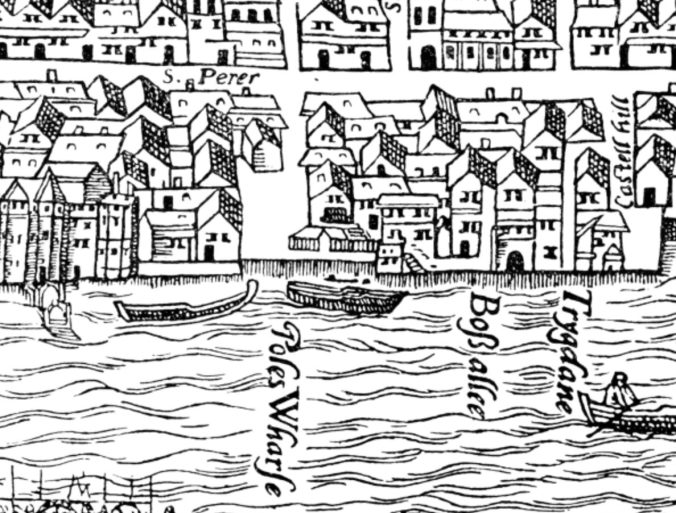
Paul’s Wharf in the Agas map (c.1562). “The Agas Map.” The Map of Early Modern London. Ed. Janelle Jenstad. 2012. Rpt. of Civitas Londinvm. [1562?]. MoEML
Stranded at Paul’s Wharf in the early hours, Mawdlen cries out for a waterman to take her south on the river. One waterman, perhaps woken from sleep, explains that it’s too early for service, but he eventually lets her in and feigns to help her with her baggage. In a particularly dramatic moment, the waterman clocks onto Mawdlen’s disguise (“he perceived what she was”) and, all the while stalling for time, sends for a constable, whereupon Mawdlen is apprehended.
Her story suggests some of the genuine social implications for the familiar dramatic devices of disguise and elopement. Mawdlen’s attempt to run away with Thomas does not have a happy ending—certainly not in the account given here—and he never keeps his appointment to meet her, as promised, at Paul’s Wharf. The record captures the romance of disguise as well as implicitly suggesting the expediency or benefits that “cross-dressing” might afford. At the same time, it points, very sadly, to the realities of policing dress and behaviour in Elizabethan England: a time and place where sumptuary laws governed what one could and could not wear (reinforced by numerous acts and precepts of “apparel” by the London council), and where acts of flagrant social transgression brought you before a court and prompted an intrusive enquiry into your sexual history. It’s unsettling to read that Mawdlen, admitting to pre-marital sex with Thomas and already brought in for “dressing in man’s apparel,” is sentenced to “correction.”
In indicating the social realities of such plots, Mawdlen might be seen as a real-life counterpart to female figures who pursue their heart’s desires in spite of difficulties in the likes of Rare Triumphs as well as in later Jacobean plays. We hear echoes of Mawdlen’s tale in the foiled elopement of Moll Yellowhammer in Thomas Middleton’s A Chaste Maid in Cheapside (c.1613): “She’s gone, she’s gone! [. . .] Over the houses. / Lay the waterside [. . .] O vent’rous baggage!” (4.1.272-25). By the water, Touchwood Junior, her lover, gives crowns to the “honest waterman” and tells them that “There comes a maid with all speed to take water, / Row her lustily to Barn Elms after me.” Moll herself, like Mawdlen alone in the early hours, suggests something of the personal risks, and the bravery, in such a plot: “I found the way more dangerous than I looked for” (4.3.19-22; 25). Similarly, Bellario’s unknown disguise as a page boy (in reality the young girl Euphrasia), in Beaumont and Fletcher’s Philaster (c.1608-10) comes as a practical “understanding well” of what must be done to stay in the presence of Philaster himself: “Whilst there was hope to hide me from men’s eyes, / For other than I seem’d; that I might ever / Abide with you.”
***
In 1582—the year of The Rare Triumphs of Love and Fortune and the year after our first commercial play, The Three Ladies of London—we meet Mrs Moodey in custody on her way to prison and learn that she is sprung by her conspiratorial friends in a violent escape attempt.
Mrs Moodey and her “friends”—a gender-neutral term that might suggest that they were not all men—exhibit a concern for rumour and reputation and refuse to follow the social and institutional structures that governed adultery and illicit sex in the city. While they allegedly see Moodey’s conveyance to the prison of Bridewell—a court and prison that dealt in part with sexual crimes and misdemeanours and where Mawdlen’s case was heard—as “so open and so reproachful a disgrace,” they nonetheless stage their own spectacle in freeing Mrs Moodey from state control.
The Privy Council write this letter, detailing the incident, in support of Mrs Moodey (who is of “good birth and alliance”). They urge the Lord Mayor to be lenient and point out that even her husband is willing to vouch for her. The letter expresses scepticism about Mrs Moodey’s complicity in the escape plan, noting that she was kept “close” and unable to communicate with anybody “whereby she might have any opportunity to devise any plot or confederacy.” The issue seems so intricate and delicate that the Lords prefer to discuss it “more largely . . . by word of mouth.”
***
These two anecdotes, gleaned from mediated records of the real people involved, are fantastic and colourful examples of female transgression in Elizabethan London. Yet they also represent a society in which both appearance and behaviour were judged at a legal level. As sometimes in drama, but often in life, the consequences ran deep—especially for those like Mawdlen, unlike Mrs Moodey, who were not “of good birth and alliance” and had no powerful figures to intercede on their behalf.

[…] and wonderful, and he’s written about the playhouses and espionage, the histories of real-life crossdressing social scandal, scrappy archives, and the unavoidable figure of Venus. He also asked us what happens if we […]